Material estimator
Estimate the materials for a whole building
Not the area you are covering — the quantity you have to order. Sheets, packs, tins, lengths and bags, with the waste included, grouped so you can hand the list to a merchant.
Free to try — no sign-up, nothing to install. How the floor planner works →
What comes out of it
In this example, a stud wall. Put in your dimensions, make your material selections, and everything else is calculated for you.
Your dimensions
Your materials
Framework
Fasteners
Cladding
Insulation
Trims and finishing
Quantities are worked out exactly. Prices are typical European merchant prices — an estimate to start from, not a quote; your local prices will differ. In the calculator you can type your own over them.
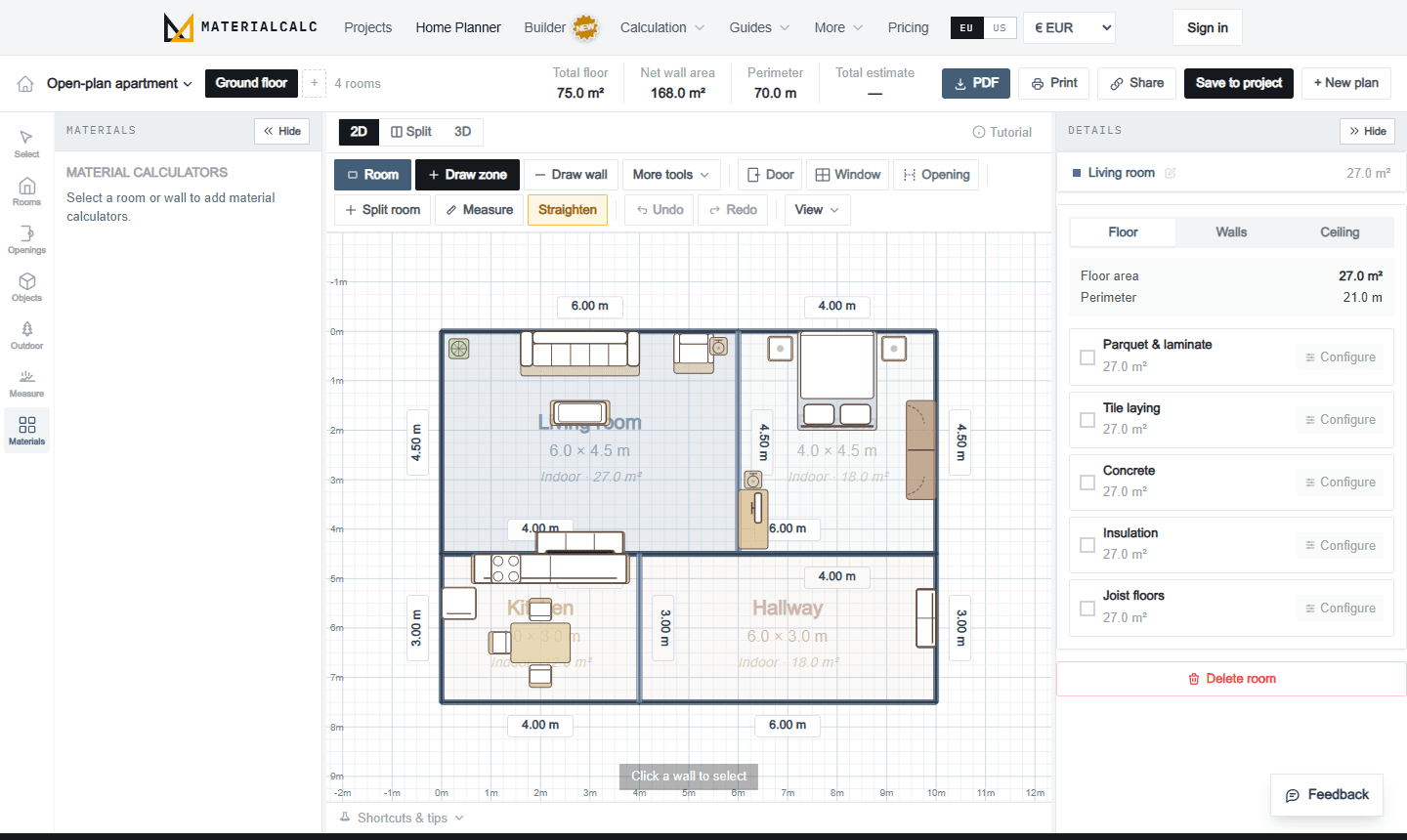
The same functionality covers floors, walls and a complete renovation. Make a simple floor plan and do a whole room straight from it, or run standalone calculations. All saved in a tidy project for full overview.
Make a free account and try it out — nothing to install.
Measure once, estimate everything
The slow part of estimating a building is not the arithmetic — it is typing the same room into six different calculations and getting one of them wrong. Draw the room once and every trade reads its measurements from it: the floor area for the flooring, the net wall area for the plasterboard and the paint, the perimeter for the skirting.
What it covers
| Floors | Flooring, tile, screed, levelling compound, underlay, joists |
| Walls | Stud framing, plasterboard, insulation, paint, wallpaper, render |
| Outside | Cladding, facade, external insulation, roofing, decking, fencing |
| Groundwork | Concrete, foundations, paving, gravel, asphalt |
| Fixings | Screws, brackets, anchors and fastener spacing for the above |
Each one is its own calculator with the inputs that trade actually needs — stud spacing, pattern and joint width, pack coverage, mix strength. Pick them from the calculator directory, or let a drawn room fill them in.
Labour hours
Labour runs 60–70% of a renovation once you hire help. Put your hourly rate and the hours on each room and they sit next to the materials in one total — estimate against actual, as the invoices arrive. The guide to pricing a job covers how the two fit together.
Quoting for clients? Pro is built for contractors and exports a watermark-free, client-ready PDF — see what is in it.
Going deeper
What goes into each trade
An estimate is only as good as knowing what the job needs. These cover the build-ups, the waste factors and the parts people forget to count.
Common questions
What is a material estimator?
A tool that turns measurements into the quantities you actually buy — sheets, packs, tins, lengths and bags — rather than the area you are covering. The two are different numbers, because materials are sold in units nobody measures a room in, and because every trade wastes at a different rate.
How do you estimate materials for a house?
Room by room, trade by trade. Measure each room once, work out each surface it needs — floor, walls, ceiling — then add what belongs to the building rather than any room, like roofing, foundations or external cladding. Totalling by room is what lets you cut a room later without re-estimating the whole job.
Is the material estimator free?
Every calculator is free to use with no account. Drawing a floor plan is free up to two rooms. Saving several projects, exporting a PDF and syncing between devices need a paid plan.
Does it include labour?
Materials are what it calculates exactly. Labour is typically 60–70% of a renovation and has to be estimated from hours per task rather than worked out from dimensions — you can record it against the project alongside the materials, but no tool can derive it from a measurement.
How accurate is a material estimate?
The arithmetic is exact; the inputs decide the rest. Quantities are only as good as the measurements and the waste factor you chose, and prices move by supplier, region and week. Treat the quantities as an order list to check against your merchant’s pack sizes, and the prices as a planning figure rather than a quote.
You estimated one wall further up this page. The planner does that for every wall, floor and ceiling in the building, off one drawing.
What it costs. Every calculator runs in full for nothing, with no account; a free account saves three of them. Everything calculates on screen either way — the caps are on keeping and exporting the work, not on doing it. The Project Pass is one payment for three months of the rest, with no subscription.
See what each plan includes